
Services
Clear services, one honest ladder.
Fixed scope where possible, honest advice always. If you are not sure which one fits, start a conversation and we will tell you — including when the answer is “you do not need us yet”. Most clients climb this ladder step by step, and training runs alongside every step.
1 · See
The SME Business Cockpit
Reports and semantic models you can trust, delivered in weeks.
If you’re just beginning, you don’t need to weigh Microsoft Fabric against Databricks yet. The SME Business Cockpit runs on a platform we’ve already chosen for you, and gets your whole business onto one clear set of reports in weeks. When you’re ready for more, the application layer below adds chat and write-back on top.

Power BI Reports and Semantic Models
Reports people actually use, built on semantic models that stay fast and consistent: clean star schemas, well-named measures, row-level security, and performance tuning.

2 · Ask & Act
Ask & Act on your data
Ask questions in plain language. Turn trusted answers into governed action.
Ask lets your team explore governed business data in natural language and receive answers grounded in trusted numbers. Act carries an approved next step into the same workflow: update a forecast, add an explanation, approve a change, or correct a governed input. The exact application follows the use case, so we shape it around the work your team is ready to do.
Ask Your Data in Plain Language
We add a natural-language layer on top of governed data, so users can ask business questions in everyday language and receive answers grounded in certified numbers, not model guesses.
Business Applications with Write-Back
An interactive application, embedded in Power BI or delivered as a web app, backed by a transactional database and APIs — so what your team enters is stored, governed, and available to other systems, not trapped in a form. Typical uses: budget and forecast entry against actuals, target setting, approval flows, and correcting master data at the source.
3 · Scale
Data platforms: Fabric & Databricks
Advisory, implementation, and the structure to stay trustworthy at scale.
Once you’re ready to invest in a full data platform — more departments, more history, more automation — we design and build it with you. Reporting stays settled either way: Power BI, the clear leader for turning data into dashboards people actually use.
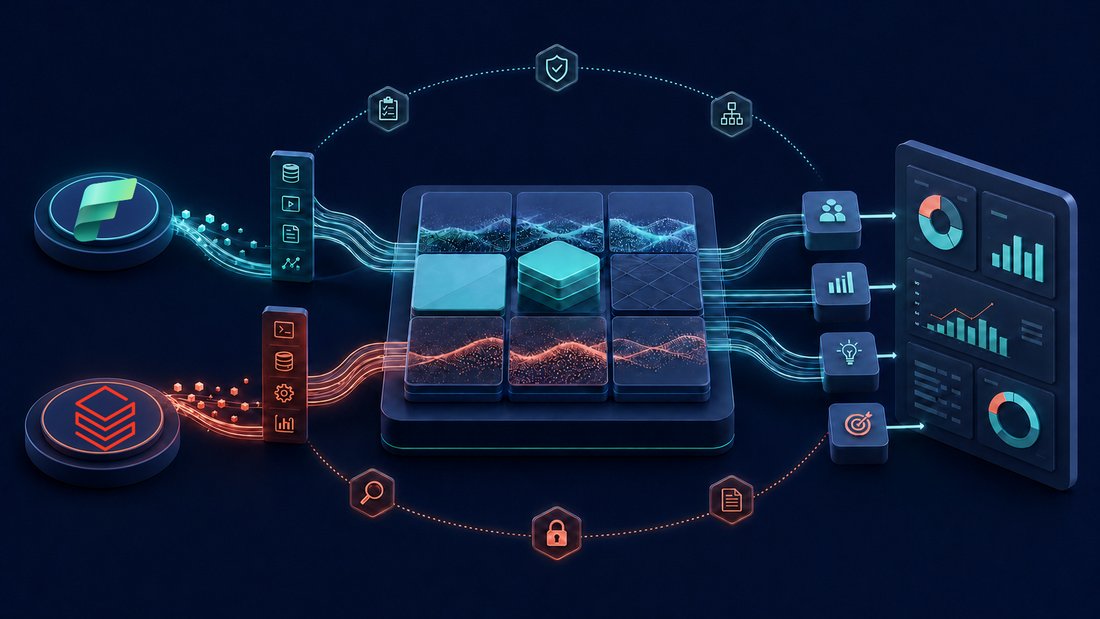
How we choose your engine — honest advice, not a product
The real decision is the transformation engine underneath: Microsoft Fabric or Databricks. We choose it with you based on your budget, your situation, and your team’s skills and maturity. Most companies fit one of three shapes, and we will tell you honestly which one is yours:
- Pure Microsoft Fabric. One platform for everything, easiest to run and own, and the cheapest to start. Our default for small and medium businesses.
- Pure Databricks. Databricks does the hardcore data engineering and machine learning; Power BI shows the reports. Best for large data volumes and complex pipelines.
- Hybrid, Databricks plus Fabric. Databricks for the deep engineering, Fabric for the last-mile transformation and reports the business owns.
Curious how the two platforms actually compare? Read our honest, vendor-neutral article, Microsoft Fabric vs Databricks in 2026: An Honest Place to Start. Or skip the reading and just start a conversation.

Data Platform Advisory
You want better reporting or analytics but are unsure what to build on. We assess your current tools and data, and recommend a platform and roadmap that fit your size and budget.

Microsoft Fabric Implementation
We set up Microsoft Fabric properly: lakehouse structure, data pipelines, semantic models, workspaces, and governance.

Databricks Data Engineering
Data pipelines and data products on Databricks: ingestion, transformation, quality checks, and orchestration.
Scaling with structure: for mature organizations
Once your platform is running and you’re building many data products, or need to prove trust in your numbers to auditors and enterprise customers, these two apply.
Data Solution Blueprint
A metadata-driven framework that generates pipelines, models, and governance artifacts from definitions instead of hand-building them, plus the procedures and training so your team actually adopts it.
Data Governance
A phased governance program: data ownership, shared business definitions, quality rules, access control, and cataloging, built into daily work.
Every step
Training
Power BI and Excel, with and without AI — taught in plain language, in English or Vietnamese.
We teach the tools we use every day, for your team and around your own data where possible. Sessions are arranged on request; tell us who should learn what, and we will propose the format.
Beginner Power BI
For: teams starting from Excel exports and manual reports.
After: read, filter, and build your first Power BI reports on trusted data.
Intermediate Power BI
For: report builders who want robust, maintainable models.
After: build clean data models, write DAX measures, and design reports people actually use.
Power BI + AI
For: analysts working with Copilot-era tools.
After: combine Power BI with AI assistance to build and check analyses faster, without trusting blind answers.
Beginner Excel
For: office staff who live in spreadsheets.
After: structure data, and use core formulas and pivot tables with confidence.
Excel + AI
For: anyone doing repetitive spreadsheet work.
After: use AI assistance to clean data, draft formulas, and speed up everyday Excel tasks safely.
Your team, your data
Sessions on request, in English or Vietnamese.
Not sure where you are on the ladder?
The first conversation is free, and we will tell you honestly what you need — including when the answer is “not us, not yet”.

