
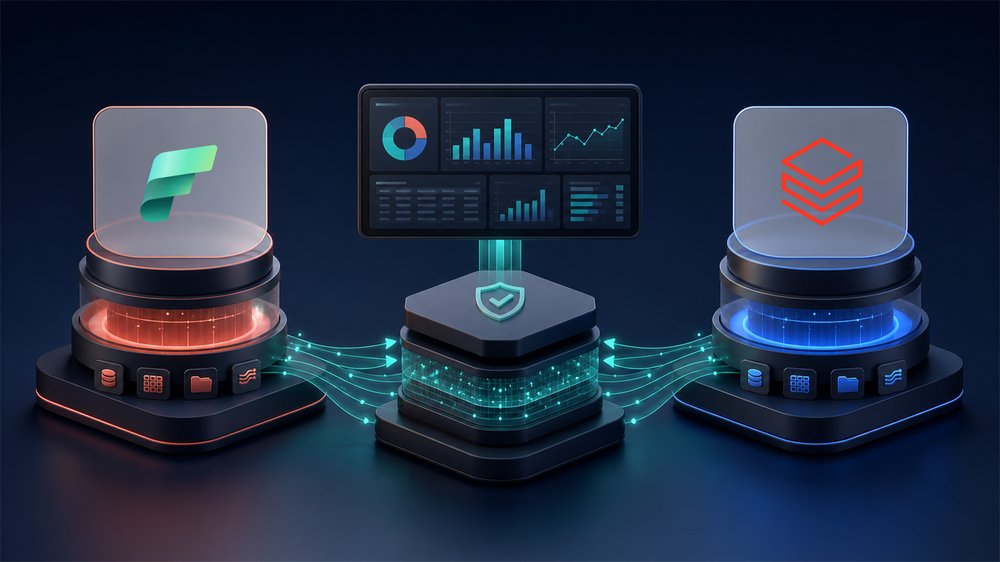
Two names come up in almost every data conversation we have: Microsoft Fabric and Databricks. This is the first part of a short series where we compare them the way we actually see them on projects, with no vendor spin. We start with the basics: what each one is, where Power BI fits, and why so many teams are stuck on the choice.
The question we keep hearing
“Should we build on Microsoft Fabric or Databricks?” We hear it from finance directors, from IT managers, and from founders who have just been told their Excel files are holding the company back. It is a fair question, and the honest answer is that it depends on your data, your team, and your budget, not on which brand is louder this year.
This series is our attempt to answer it properly. We build on both platforms, so we have no reason to sell you one over the other. In this first part we set the scene. In the next parts we go deep on each platform’s strengths and weaknesses, on how the two are converging, and finally on a simple way to decide.
What Microsoft Fabric is
Microsoft Fabric is a single, unified data platform. It brings data engineering, data storage, modelling, and reporting into one place, on top of shared storage called OneLake. Crucially, Power BI is now a part of Fabric, so the reports your business already knows live in the same platform as the pipelines that feed them.
Fabric is new. Microsoft launched it in November 2023, which makes it about two and a half years old as we write this. That youth cuts both ways, and we will be specific about it in part two. What matters here is the shape: one platform, low-code and professional-code side by side, with the best business-intelligence experience on the market built in.
What Databricks is
Databricks is older and was built from a different starting point. It was founded in 2013 by the creators of Apache Spark, and it grew up serving serious data engineering and machine-learning teams. It is a lakehouse platform: open data formats, large-scale processing, and a deep set of tools for engineers and data scientists who want full control.
If Fabric’s instinct is “make it approachable for everyone”, Databricks’ instinct is “give the engineers real power”. Both instincts are valuable. They just serve different rooms.
Where Power BI fits, and why it is not a third option
This trips people up, so we will be blunt. Power BI is not a third platform competing with Fabric and Databricks. Power BI is the reporting layer, the thing that turns modelled data into dashboards people actually open. It is very popular, and rightly so. But on its own it is not a data platform, and it cannot do the engineering work underneath.
The clean way to see it: there are two platforms, Microsoft Fabric and Databricks, and one shared reporting surface, Power BI, that can sit on top of either. When we say “Microsoft Fabric”, Power BI is already included. When we build on Databricks, we usually still put Power BI on top for the reports.
Why the choice feels hard
The choice feels hard because both platforms are good, and because they are moving toward each other. Databricks is adding stronger reporting and operational features. Fabric is adding stronger engineering features. Both are racing to embed artificial-intelligence agents directly into the platform so that more of the building can be described in plain language. We will spend a whole part of this series on that convergence, because it changes the honest answer.
For now, hold three simple ideas:
- Fabric is the most approachable and the cheapest to start, and it is unbeatable if your world is already Microsoft and Power BI.
- Databricks is the most powerful for heavy, complex engineering and machine learning, and it scales without flinching.
- You do not always have to choose. A hybrid, Databricks underneath and Fabric for the last mile and the reports, is a real and increasingly common shape.
How we will decide, later in this series
By the last part we will give you a short checklist: how much data, how complex the pipelines, how much machine learning, how Microsoft-aligned your team is, and how tight the budget is. Those five questions settle most cases. If you cannot wait for the series, that list is also the fastest way to start a conversation with us.
In part two, we look hard at Microsoft Fabric on its own: what it is genuinely great at today, and where its youth still shows.
This is part one of a five-part series. Synnoia builds on both Microsoft Fabric and Databricks, and delivers reporting through Power BI. The first conversation is free.


